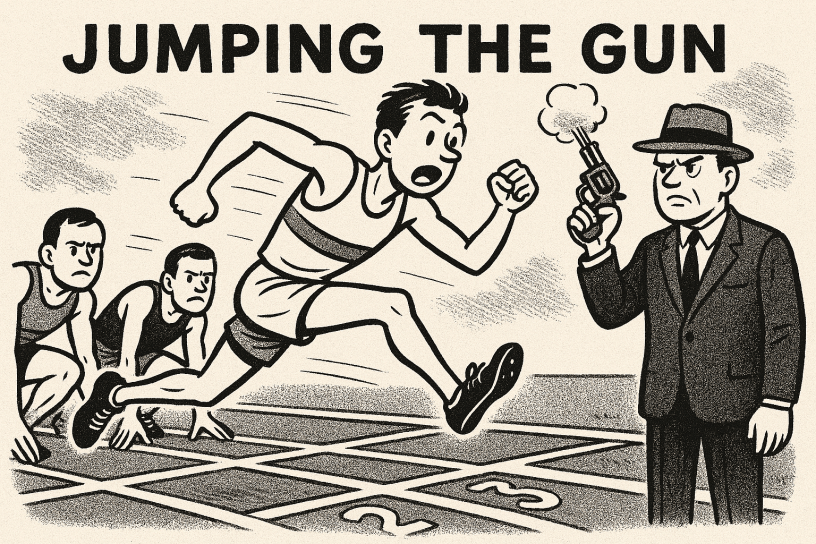
In recent months I have encountered a number of cases where a claimant has been prevented or their ability to proceed with an unfair dismissal claim has been put in doubt by Respondents. In each case, the claimant made a complaint too early. This suggests there is a wider misunderstanding among claimants. When relied upon, this misunderstanding risks denying them a chance to challenge their dismissal on its merits.
It is (fairly) well known that if a person has been dismissed they have a three month (less one day) time limit to commence ACAS Early Conciliation on a prospective unfair dismissal complaint. If a claim is not made within that time then the subsequent ET claim is likely to be out of time.
The statutory basis for the three month period is section 111(2)(a) of the Employment Rights Act 1996 which states an employment tribunal cannot consider an unfair dismissal complaint unless it is presented (allowing for any extension of time limits because of ACAS Early Conciliation) “before the end of the period beginning with the effective date of termination”.
The key issue which these employees have misunderstood is that the general rule is that an employee must have actually been dismissed in order to claim unfair dismissal, it is not enough to know that they are going to be dismissed. In short (and again with one exception), in order to claim unfair dismissal the claim must be started after the effective date of termination which is the actual date the employment ends. It is not unusual for an employee to know they are going to be dismissed but for the actual date of termination (EDT) to be in the future.
For example:
- Scenario One – An employee could be accused of gross misconduct with a disciplinary hearing scheduled on a Friday. On Wednesday he is informally told he is going to be dismissed on the Friday without any notice pay. If he submits an unfair dismissal claim on the Thursday the claim is (probably – there may be some argument here) made before the EDT the tribunal will strike out the claim as it only has jurisdiction when the claim is made after the EDT (s.112(a) ERA 1996). This scenario was considered in Rai v Somerfield Stores [2004] IRLR 124, EAT where this was confirmed. If the employee waited to Saturday after he was told he was summarily dismissed (the claim would be valid and once the ET can consider. An unfair dismissal claim will be likely to be struck because the claimant ‘jumped the gun and made the claim too early.’
- Scenario Two – An employee is on a fixed term contract that expires on 31 December 2025. On 1 December 2025 she is informed the contract will not be renewed. There is no doubt that a non-renewal of a fixed term contract is a dismissal (s.95(1)(b) ERA 1996) so that she knew she was going to be dismissed. If the employee makes an ET claim for unfair dismissal before 31 December 2025 this will be before the EDT (31 December 2025) and so likely to be struck out, a claim after 31 December 2025 would not be. This scenario was considered in Throsby v Imperial College [1977] IRLR 337 where this was confirmed. An unfair dismissal claim will be likely to be struck because the claimant ‘jumped the gun and made the claim too early.’
- Scenario Three (the exception) – An employee is entitled to four weeks notice. The employer decides to dismiss the employee and gives them their four weeks notice. Because section 111(3)ERA 1996 creates an exception that that an ET can consider an unfair dismissal claim if it is issued before the EDT but after notice of dismissal is given. In this scenario the employee can wait until after the EDT (the expiry of the notice period) but can also make a a claim before the EDT within the notice period because section 111(3) specifically allows this. Therefore, unlike scenario one and two, a unfair dismissal claim before the EDT is not ‘jumping the gun’.
Every year claimants (and claimants who, if they did not jump the gun, would have strong unfair dismissal complaints) are denied the opportunity to have their complaints considered because they ‘jump the gun’. It is easy to see how that happens. In the immediate aftermath of discovering they are going to be dismissed thoughts quite understandably turn to making an unfair dismissal complaint; the question of whether the complaint is about an upcoming dismissal the is unfair or an actual dismissal that is unfair is likely to be a technicality that does not enter their thoughts.
This shows the importance of avoiding kneejerk claims – a little forbearance in responding to bad news and the risk of jumping the gun is much reduced.
Of course, if a mistake is made and a claimant is still within the limitation period the mistake can be rescued, a new claim (after the EDT) or amendment can be made but without good advice at an early stage the mistake may be unrepairable. Suppose (and unfortunately the example is based in experience) a claimant jumps the gun and makes an unfair dismissal claim too early but is unaware of that fact. With ET delays being what they are it may not be for some months before an ET tells the claimant about the problem but by then the three month period to make a claim after the EDT has long since expired.
Without knowing there was a problem the claimant would find their unfair dismissal claim struck out and the time limit to make a new claim expired, meaning the chance of a new claim being accepted out of time is not guaranteed and likely to be resisted. A claimant could argue the claim was made as soon as was reasonably practicable based on the inadvertent mistake about when an unfair dismissal could first be made – the claimant may be successful but may not be.
The key takeaway is if you are seeking to make a claim for unfair dismissal, then you should not normally initiate this (including ACAS Early conciliation) until until after the EDT. In a summary dismissal case this means the date you are told you have been dismissed, in a dismissal with notice case this means the date the notice period ends (but this where the exception applies), and in a non-renewal of fixed term contract case it is the date the end date of the contract is reached. For advisers, making sure employees are aware of the risk of jumping the gun is a key factor in ensuring that claimant’s can make valid complaints of unfair dismissal determined on their merits and not defeated by a technicality. Or, to put in in clichéd form: don’t jump the gun but rather hold your horses!
 Employment Writes
Comments are closed.