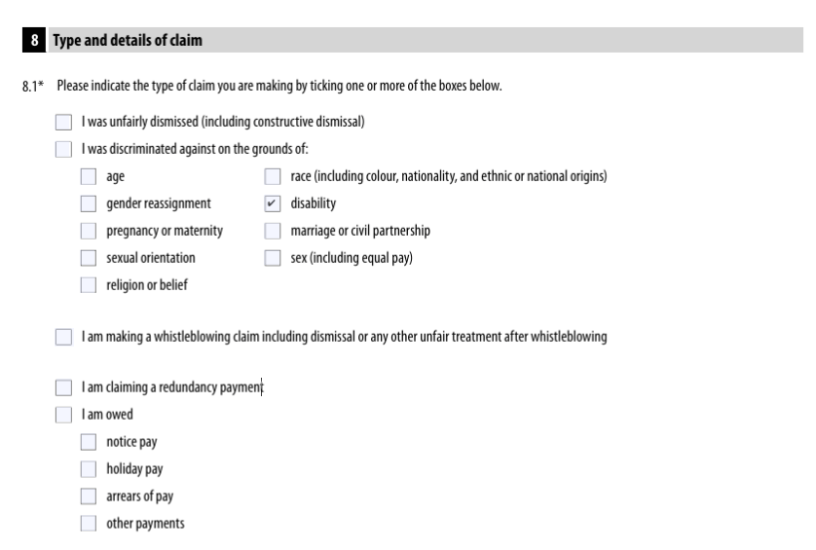
I recently assisted a claimant in a Preliminary Hearing for Case Management. The claimant had ticked the box on the ET1 form to say she wanted to make a disability discrimination but in section 8.2 of the forms which asks a claimant to “Please set out the background and details of your claim in the space below. The details of your claim should include the date(s) when the event(s) you are complaining about happened” she entered no details at all.
Here’s the thing, when the factual background became clear she did have a really solid legal case, although had entirely failed to explain it in the form (although because there was a unfair dismissal claim too some of the claim could arguably by inferred by that context – Trustees of the William Jones’s School Foundation v Parry [2018, ICR 1807, CA).
Fortunately, we were able to prepare detailed particulars of claim and get these accepted as an amendment of the claim and in due course settle the case on terms the claimant was happy with. But going into that Preliminary hearing on a case that had no particulars advanced at all other than one solitary tick box completed for the main claim I was worried the claim could end up being directed for a strike out hearing on the basis the claim could not be responded to or otherwise be rejected.
Shortly after that hearing the EAT gave judgment in the case of The Scottish Ambulance Service Board v Chapman [2025] EAT 64. On 27 May 2024 submitted an ET1 form and ticked the box at section 8.1 of the form to say complaining about disability discrimination.
At section 8.2 (which needs to be completed) the claimant was asked to give “details of the claim, including relevant dates of events complained about.” The claimant did not do so.
When a claimant wishes to make a complaint of discrimination, they should tick the relevant box or boxes at 8.1 of the ET1 form. Later the judge ordered the claimant to provide details of the claim form pursued within 14 days (the ET therefore accepted the claim but made case management directions). The EAT was about whether, by doing that, the ET had made an error of law.
Rule 12 of the 2013 Employment Tribunal Rules of Procedure (the same Rule is now found in Rule 13 of the Employment Tribunal Rules of Procedure 2024) requires that the ET “must” refer the case for a decision whether claim form should be be rejected because “it cannot sensibly be responded to”. The employer argued that under this Rule the employer could not know what the complaint was about at all except that it involves disability and so could not be responded to. Therefore what the ER should have done is consider rejecting the ET1 claim form rather than asking the claimant for more details of the claim.
If a tribunal decides that a claim cannot be sensibly be responded to then the “Tribunal must reject a claim” (Rule 13(2)).
The judgment of the EAT was that “The complete absence of any information whatsoever about the nature of the claim, other than the fact that it is said to come under the heading of ‘disability’ means, for all the reasons advanced by the respondent, that it cannot sensibly respond” and therefore needed to be considered for rejection. The EAT continued that “follows that a case management decision to allow time for further particularisation of the claim to be made without the claim form having first been seen by an Employment Judge and that Judge being satisfied that the ET had jurisdiction in respect of the claim was also an error, as submitted under the second ground of appeal” (Paragraphs 17-18).
What the Case Means
It is a common (mis)perception that filing an ET1 claim just ‘starts the ball rolling’ and that all the substance of the complaint can be added to a claim later on. This case shows that can cause serious problems for claimants.
A case being rejected is different from a case being dismissed in that a claim can be remade with the Employment Tribunal if it has been rejected. This means that if a rejection is early enough a claimant can correct the errors, provide more detail, and remake the claim within the three month window that usually applies for making a claim (a good reason why not to leave claims to the last minute). But that is a best case scenario; with employment tribunal delays it is more likely by the time you are told there is a problem the time limit for making a valid claim is already expired and that means there will be future legal argument about whether the ET can continue be heard.
The key learning point for claimants and union representatives drafting particulars of claim (the description of events in part 8.2 of the ET1) is never to treat this as something to be completed later. It is OK not to be sure what the exact type of discrimination is, but you do and least need to set out the central complaints and facts about the case.
The ET have produced some explainer videos and this is a good one on how to make sure your ET1 claim form includes everything needed and therefore gives the best chance to avoid problems like that experienced by Mr Chapman – where not including relevant information in an ET1 form is not just an administrative oversight but could make or break the whole employment tribunal case:
___
Want to stay updated?
This blog is specifically for the benefit of trade union reps and members but I hope will be of interest more widely to other advisors, and workers. If you are not a union member then now is a good time to put that right, the TUC offers help selecting the right union to join (although feel free to message me if you’re unsure about what’s best and I am happy to make a suggestion depending on your circumstances).
If you are among the number of employment lawyers and paralegals who
work in the legal sector following this blog why not join the Legal Sector Workers United (LSWU)?
If you have found this post or site helpful please think about subscribing to the email list by entering your email address below or by liking the blog on Facebook.
 Employment Writes